
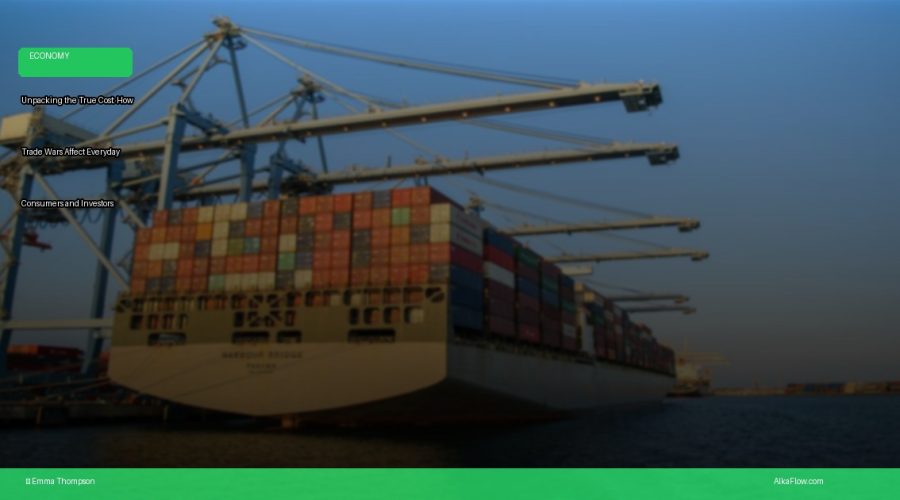
Have you ever paused to consider how the intricate dance of global trade wars truly impacts your daily life and investment portfolio? As someone who has covered global markets since 2015, I’ve seen firsthand how these high-stakes economic skirmishes, often waged with tariffs and quotas, send ripples far beyond the negotiating tables. They don’t just affect multinational corporations or government balance sheets; they directly influence the prices you pay, the products you can buy, and the value of your savings.
📋 Table of Contents
Understanding these dynamics is crucial, especially in our interconnected world where a dispute between two major economies can quickly become a global phenomenon. From the cost of your morning coffee to the performance of your retirement fund, the unseen hand of trade policy is often at play. Let’s delve into the tangible and often surprising ways these conflicts reshape our economic landscape, affecting both the average household and the astute investor.
The Immediate Ripple: How Trade Wars Hit Your Wallet

When nations engage in trade disputes, the most immediate and visible impact is often felt directly by consumers. Governments typically impose tariffs – taxes on imported goods – as a primary weapon. These tariff costs are rarely absorbed entirely by the importing companies; instead, they are often passed down the supply chain, ultimately landing in the price tag you see at the store. (See also: A Strong US Dollar: What It Means for Emerging Markets | AlkaFlow)
Higher Prices and Reduced Choice for Consumers
Think back to the US-China trade war that escalated significantly between 2018 and 2019. Tariffs were placed on a wide array of goods, from steel and aluminum to electronics and clothing. For instance, American consumers faced higher prices on goods like washing machines, with some reports indicating price hikes of up to 12% in the wake of tariffs. Suddenly, that new appliance you needed became significantly more expensive, eating into your disposable income.
Beyond just higher prices, trade wars can also limit consumer choice. If tariffs make certain imported goods prohibitively expensive or if companies decide to stop importing them altogether, the variety of products available on shelves can shrink. This forces consumers to either pay more for domestic alternatives, accept lower quality, or simply go without. The overall effect is a decrease in purchasing power and a less competitive marketplace, leading to noticeable inflationary pressures on everyday essentials and durable goods alike.
Job Market Implications and Local Economies
While some argue that tariffs protect domestic jobs, the reality is often more complex and nuanced. While certain protected industries might see a temporary boost, others that rely on imported components or export their finished products can suffer. For example, American farmers were hit hard by retaliatory tariffs from China, leading to significant losses in soybean and pork exports. This created immense financial strain and job insecurity in agricultural communities, necessitating government bailout packages.
Conversely, businesses that depend on cheap imported parts might find their production costs soaring, potentially leading to layoffs or reduced hiring. The ripple effect can be felt throughout local economies, impacting small businesses that serve these affected industries and their employees. The overall job market can experience increased volatility and shifts, as companies adapt to new trade landscapes, sometimes by relocating production facilities or automating processes.
Navigating Investment Volatility During Trade Wars
For investors, trade wars introduce a layer of unpredictability that can make navigating financial markets exceptionally challenging. The sheer uncertainty surrounding future trade policies, tariff rates, and retaliatory measures creates significant jitters.
Market Volatility and Sectoral Shifts
Stock markets notoriously dislike uncertainty, and trade disputes are a prime source of it. We’ve seen periods where a single tweet or a snippet of news about trade negotiations could send indices like the S&P 500 or the Dow Jones Industrial Average swinging wildly. Sectors that are heavily reliant on international trade, such as manufacturing, technology, and agriculture, often bear the brunt of this volatility. Companies with extensive global supply chains are particularly vulnerable, as their profit margins can be squeezed by increased costs and reduced market access.
Consider the tech sector during the US-China trade tensions, where companies like Apple faced concerns over both their production facilities in China and their access to the vast Chinese consumer market. Conversely, some domestic industries that gain protection from tariffs might see a temporary uplift, creating a dynamic environment where sector-specific performance can diverge sharply.
Corporate Earnings and Guidance
Trade wars directly impact corporate earnings. Companies facing higher input costs or reduced export opportunities will likely report lower profits. This directly affects stock valuations and can lead to downward revisions in earnings guidance, further spooking investors. Many companies, during the height of the US-China trade conflict, explicitly cited tariffs as a headwind in their quarterly earnings calls.
Beyond direct financial hits, the overall economic uncertainty generated by trade wars can lead businesses to delay investment in new projects, expansion, or research and development. This cautious approach can stifle innovation and long-term growth prospects, making it harder for investors to gauge future performance.
Global Investment Strategies and Currency Fluctuations
Trade wars don’t just affect equity markets; they have a profound impact on currency markets and global investment strategies. When a country imposes tariffs, it can strengthen its own currency in the short term as demand for its goods theoretically increases (though often offset by retaliatory tariffs). Conversely, countries facing tariffs might see their currency weaken as exports decline. These currency fluctuations can significantly affect the returns on international investments.
For an investor holding assets denominated in a foreign currency, a weakening of that currency against their home currency can erode gains or exacerbate losses, even if the underlying asset performs well. This adds another layer of complexity for those with diversified international portfolios, requiring careful monitoring of geopolitical developments and their potential impact on exchange rates.
Beyond the Headlines: Long-Term Consequences of Trade Wars
While the immediate effects are often discussed, the long-term consequences of protracted trade conflicts can fundamentally reshape global commerce and economic structures.
Supply Chain Reconfigurations and Reshoring
One of the most significant long-term impacts is the acceleration of supply chain disruptions and a push towards reconfiguration. Companies that once optimized for efficiency and cost by centralizing production in certain countries are now rethinking their strategies. The risk of tariffs, political instability, and the desire for greater resilience are driving many to diversify their manufacturing bases or even ‘reshore’ production back to their home countries or to politically friendlier nations.
This shift is not cheap or quick. It involves substantial investment in new factories, logistics networks, and workforce training. While it might create some domestic jobs, it can also lead to higher production costs in the long run, which, again, are often passed on to consumers. This re-drawing of global production maps signifies a move away from the hyper-globalized model that defined the late 20th and early 21st centuries.
Innovation, Competitiveness, and Geopolitical Relations
Trade wars can stifle innovation by increasing the cost of essential components, limiting access to global markets for cutting-edge products, or reducing the free flow of ideas and talent. For example, restrictions on technology transfers or specific company blacklistings can hinder collaborative research and development, slowing down progress in critical areas like AI, 5G, and biotechnology. (See also: Understanding Stagflation: When Inflation and Recession Hit Simultaneously | AlkaFlow)
Furthermore, prolonged trade conflicts can erode international trust and cooperation, leading to a more fragmented global economy. This can have broader geopolitical consequences, affecting alliances, diplomatic efforts, and the ability to address pressing global challenges like climate change or pandemics. The long-term competitiveness of nations can be undermined if they become isolated from key markets or technological advancements.
According to a 2019 report by the National Bureau of Economic Research, U.S. tariffs were almost entirely passed through to domestic prices, indicating that the burden fell on American consumers and importing firms, rather than being absorbed by foreign exporters.
My Perspective
As I reflect on years of covering these complex market shifts, it’s clear that the narrative surrounding trade wars often simplifies a multifaceted reality. They are not merely economic chess games played by politicians; they are seismic events that reverberate through every layer of the economy, touching individuals and institutions alike. The lessons learned from recent conflicts underscore the importance of diversification, staying informed, and maintaining a long-term perspective in both personal finance and investment strategy.
Understanding how trade wars affect your finances isn’t just an academic exercise; it’s a critical component of informed decision-making in a globalized world. Whether you’re planning your next big purchase or strategizing your investment portfolio, keeping an eye on these global economic currents is paramount. Empower yourself with knowledge, adapt to change, and always seek to understand the broader implications of headlines that often mask deeper economic shifts.
❓ Frequently Asked Questions
What is a trade war?
A trade war occurs when countries impose tariffs or other barriers to trade in response to protectionist measures by another country. It’s essentially an economic conflict where nations try to harm each other’s trade.
How do trade wars increase prices for consumers?
Trade wars increase prices by imposing tariffs (taxes) on imported goods. Companies often pass these increased import costs onto consumers, leading to higher prices for a wide range of products.
What are the main risks for investors during a trade war?
Investors face risks such as increased market volatility, reduced corporate earnings due to higher costs or lost markets, and unfavorable currency fluctuations, all stemming from heightened economic uncertainty.
Can trade wars lead to job losses?
Yes, trade wars can lead to job losses in industries that rely heavily on exports affected by retaliatory tariffs or in sectors that depend on imported components that become more expensive, forcing companies to cut costs or relocate.
How can consumers and investors protect themselves during a trade war?
Consumers can mitigate impact by budgeting carefully and seeking domestic alternatives. Investors should diversify portfolios, consider defensive assets, stay informed on geopolitical developments, and maintain a long-term perspective to weather short-term volatility.




0 Comments